Minimum wage in Minnesota, 1968–2027
- Minimum wage in 2026
$11.41 an hour1
In force since Jan 1, 2026, per Minnesota Department of Labor and Industry.
- Federal minimum wage
$7.25 an hour2
In force since Jul 24, 2009; Minnesota's 2026 rate is 1.57 times it.
- On January 1, 2027
$11.87 an hour1
Up $0.46 from today.
- Tipped employees
$11.41 an hour in cash3
Tipped employees get the full minimum wage before tips.
- Overtime
Time and a half after 48 hours a week4
At $11.41 an hour: at least $17.12 for each overtime hour, for employees who are not exempt.
- Overtime under federal law
Time and a half after 40 hours a week (federal FLSA)5
For covered employees who are not exempt.
- Minneapolis minimum wage
$16.37 an hour6
Per City of Minneapolis, Labor Standards Enforcement: “The required minimum wage rate for work performed in Minneapolis during 2026 is $16.37. In 2027, the Minneapolis minimum wage is $17.02.”
- Minneapolis from Jan 1, 2027
$17.02 an hour6
Per City of Minneapolis, Labor Standards Enforcement: “The required minimum wage rate for work performed in Minneapolis during 2026 is $16.37. In 2027, the Minneapolis minimum wage is $17.02.”
- Saint Paul minimum wage
$16.37 an hour7
Businesses with 101 or more employees since January 1, 2026, and 6 to 100 since July 1, 2026; $14.25 with 5 or fewer, per City of Saint Paul, Labor Standards Enforcement and Education.
- Saint Paul from Jan 1, 2027
$17.02 an hour8
101+ employees from Jan 1, 2027; 6 to 100 stay at $16.37 until July 1; 5 or fewer: $14.25, then $15.00 from July 1, per City of Saint Paul, Labor Standards Enforcement and Education.
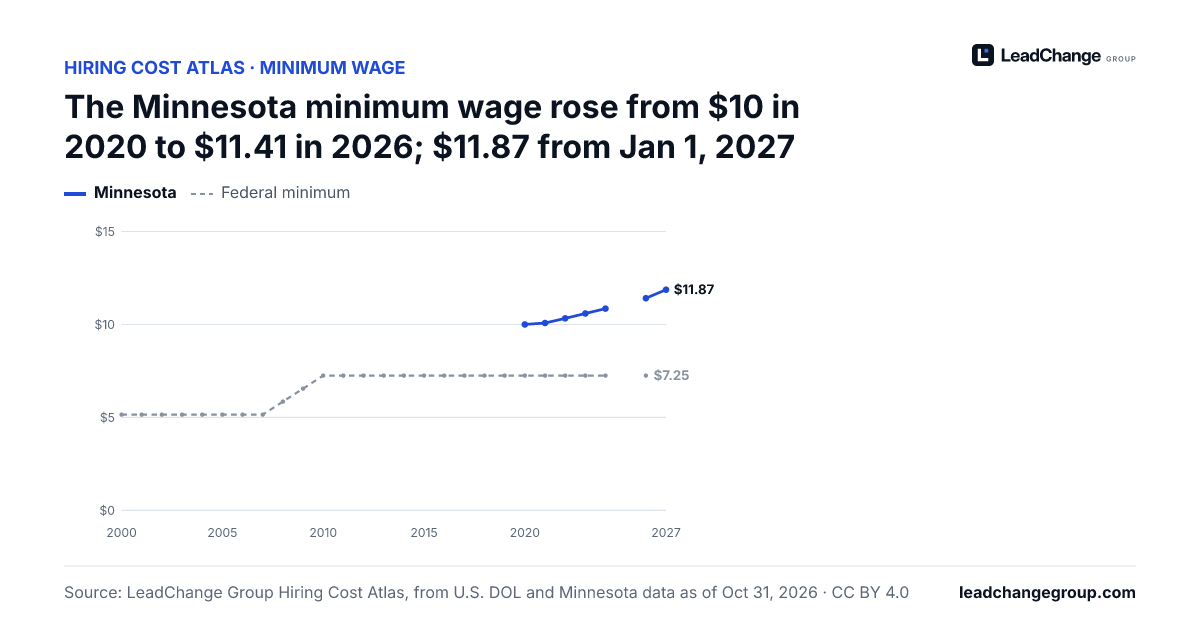
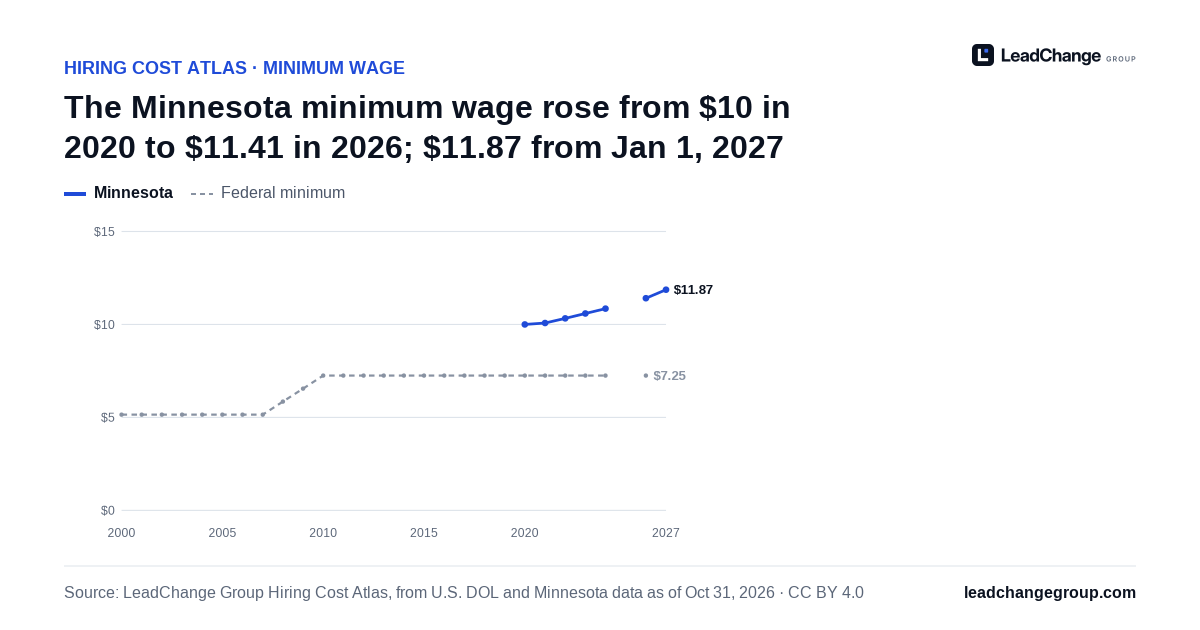
The Minnesota minimum wage rose from $10 in 2020 to $11.41 in 2026; $11.87 from Jan 1, 2027
Line chart of the Minnesota minimum wage against the federal minimum: $10 in 2020, $11.41 in 2026, and $11.87 in 2027. The federal minimum was $5.15 in 2000 and $7.25 in 2026.
What a full-time minimum-wage employee costs in Minnesota
At $11.41 an hour for 40 hours a week, a new employer with 10 staff pays $23,733 in wages and $2,444 on top (10.3%) in payroll taxes and workers' comp. At the 2027 rate of $11.87 with 2026 payroll tax rates: $27,230 a year. Minnesota publishes a new-employer unemployment rate per industry; this uses its rate for wholesale trade (choose yours in the calculator).
- Wages (2,080 paid hours a year)
- $23,733
- Social Security (employer share)6.2%10 of $23,733
- $1,471
- Medicare (employer share)1.45%11 of $23,733
- $344
- FUTA (federal unemployment tax)0.6% (full 5.4% credit: state tax paid in full and on time)12 (not on the DOL's final 2026 reduction list)13 of $7,00012
- $42
- State unemployment insurance (new employer)1% (new-employer rate for wholesale trade)14 of $23,73315
- $237
- Minnesota Paid Leave (employer's minimum share)0.22%16 (small employer: ≤ 30 staff, pay ≤ 150% of state avg)17 of $23,733
- $52
- Workers' compensation (benchmark index rate, 2024 study)$1.25 per $100 of payroll, rates in effect Jan 1, 202418
- $297
- Total a year
- $26,177
If you also offer single health coverage, the average employer here pays about $6,647 more a year: a $8,586 average premium19 less $1,939 paid by the employee19.
Frequently asked questions
What is the minimum wage in Minnesota in 2026?
$11.41 an hour since Jan 1, 2026: $23,733 a year at full time.
What will the minimum wage be in Minnesota in 2027?
$11.87 an hour from Jan 1, 2027, after $11.41 an hour in 2026: $24,690 for a full-time year.
What is the minimum wage for tipped employees in Minnesota?
$11.41 an hour before tips: Minnesota allows no tip credit.
How much does a minimum-wage employee cost an employer in Minnesota?
About $26,177 a year full time at $11.41: $23,733 of pay plus $2,444 on top, $2,147 in payroll taxes and $297 in workers' comp, before any health coverage.
How has the Minnesota minimum wage changed since 2000?
The Minnesota minimum wage rose from $10 in 2020 to $11.41 in 2026; $11.87 from Jan 1, 2027.
When do Minnesota employers have to pay overtime?
After 48 hours in a workweek, at one and one-half times the regular rate (at least $17.12 an hour at $11.41), for employees who are not exempt, per the U.S. DOL's table of state laws. Employers covered by the federal FLSA owe it after 40 hours a week.
More minimum wage and employer cost pages
Employer costs in Minnesota
States with a similar minimum wage
Data and rules for every state
Sources
The 19 pages this page's facts come from. The date beside each is our last check of the facts taken from it (the oldest, when they differ). The numbers beside the figures above link here.
Quotes from the sources
- Minnesota Department of Labor and Industry dli.mn.gov/business/employment-practices/minimum-wage-minnesota“Amount as of Jan. 1, 2026 Amount as of Jan. 1, 2027 State minimum wage $11.41 an hour $11.87 an hour” “Effective Jan. 1, 2027 , Minnesota’s minimum-wage rate will be adjusted for inflation to $11.87 an hour for all employers in the state.”
- U.S. Department of Labor, Wage and Hour Division dol.gov/agencies/whd/minimum-wage“The federal minimum wage is $7.25 per hour effective July 24, 2009.”
- U.S. Department of Labor, Wage and Hour Division dol.gov/agencies/whd/state/minimum-wage/tipped“Definition of Tipped Employee by Minimum Tips received (monthly unless otherwise specified) … State requires employers to pay tipped employees full state minimum wage before tips … Minnesota $11.41”
- U.S. Department of Labor, Wage and Hour Division dol.gov/agencies/whd/minimum-wage/state“Minnesota … Basic Minimum Rate (per hour): $11.41 … Premium Pay After Designated Hours 1 : Weekly - 48 … The overtime premium rate is one and one-half times the employee's regular rate, unless otherwise specified.”
- U.S. Department of Labor, Wage and Hour Division Overtime Pay - US Department of Labor“Unless exempt, employees covered by the Act must receive overtime pay for hours worked over 40 in a workweek at a rate not less than time and one-half their regular rates of pay.”
- City of Minneapolis, Labor Standards Enforcement minimumwage.minneapolismn.gov“The required minimum wage rate for work performed in Minneapolis during 2026 is $16.37. In 2027, the Minneapolis minimum wage is $17.02.”
- City of Saint Paul, Labor Standards Enforcement and Education stpaul.gov/news/saint-paul-businesses-notified-2026-minimum-wage-increases“Effective January 1, 2026, the City’s minimum wage hourly rate will be: $16.37 for macro and large businesses (101+ employees) Effective July 1, 2026, the minimum wage hourly rate will be: $16.37 for small businesses (6-100 employees) $14.25 for micro businesses (5 employees or less)”
- City of Saint Paul, Labor Standards Enforcement and Education stpaul.gov/news/announcing-city-saint-paul-minimum-wage-rates-2027“Effective January 1, 2027, the minimum wage hourly rate will be: $17.02 for large and macro businesses (101+ employees) $16.37 for small businesses (6–100 employees) $14.25 for micro businesses (5 employees or fewer) Effective July 1, 2027, the minimum wage hourly rates will be: $17.02 for large and macro businesses (101+ employees) $17.02 for small businesses (6–100 employees) $15.00 for micro businesses (5 employees or fewer)”
- U.S. Department of Labor, Wage and Hour Division Changes in Basic Minimum Wages in Non-Farm Employment Under State Law: Selected Years 1968 to 2024“Minnesota .70 - 1.15(b) .70 - 1.15(b) .75 - 1.60 1.80 2.30 2.90 3.10 … Minnesota 3.55 & 3.50(f) 4.25(g) 4.25(g) 4.25(g) 4.25(g) 4.25(g) 5.15(g) … Minnesota 4.90 - 5.15(g) 4.90 - 5.15(g) 4.90 - 5.15(g) 4.90 - 5.15(g) 4.90 - 5.15(g) 4.90 - 5.15(g) 5.25 - 6.15(g) … Minnesota 5.25-6.15(g) 5.25-6.15(g) 5.25-6.15(g) 5.25-6.15(g) 5.25-6.15(g) 5.25-6.15(g) 5.25-6.15(g) … Minnesota 6.50-8.00(g) 7.25-9.00(g) 7.25-9.50(g) 7.75-9.50(g) 8.04-9.86(g) 8.15-10.00(g) … Minnesota 10.00(g) 10.08(g) 10.33(g)…” “Federal (FLSA) $1.15 & $1.60 $1.30 & $1.60 $1.60 $2.20 & $2.30 $2.90 $3.10 $3.35 … Federal (FLSA) $3.35 $3.80 $4.25 $4.25 $4.25 $4.75 $5.15 … Federal (FLSA) $5.15 $5.15 $5.15 $5.15 $5.15 $5.15 5.15 … Federal (FLSA) 5.15 5.85 6.55 7.25 7.25 7.25 7.25 … Federal (FLSA) 7.25 7.25 7.25 7.25 7.25 7.25 … Federal (FLSA) 7.25 7.25 7.25 7.25 7.25” “For the years indicated, the laws in Arizona, Arkansas, California, Colorado, Kentucky, Minnesota, Ohio, Utah, and Wisconsin applied only to women and minors.” “For the years 1988 to 1990, Minnesota had a two tier schedule with the higher rate applicable to employers covered by the FLSA and the lower rate to employers not covered by the FLSA.” “Minnesota sets a lower rate for enterprises with annual receipts of less than $500,000 ($4.90, January 1, 1998-January 1, 2005). The dollar amount prior to September 1, 1997 was $362,500 ($4.00 - January 1, 1991-January 1, 1997).”
- Internal Revenue Service IRS Publication 15 (Circular E), Employer's Tax Guide“For 2026, the social security tax rate is 6.2% (amount withheld) each for the employer and employee (12.4% total).”
- Social Security Administration ssa.gov/oact/cola/cbb.html“Tax rates under the HI program are 1.45 percent for employees and employers, each, and 2.90 percent for self-employed persons.”
- Internal Revenue Service Topic no. 759, Form 940 – FUTA tax (IRS)“If you're entitled to the maximum 5.4% credit, the FUTA tax rate after credit is 0.6%. You're entitled to the maximum credit if you paid your state unemployment taxes in full, by the due date of your Form 940, and on all the same wages as are subject to FUTA tax and the state isn't determined to be a credit reduction state.” “FUTA tax rate: The FUTA tax rate is 6.0%. The tax applies to the first $7,000 you paid to each employee as wages during the year.”
- U.S. Department of Labor, Employment and Training Administration oui.doleta.gov/unemploy/docs/final_credit_states_2026.xlsx“Final 2026 Federal Unemployment Tax Act (FUTA) Credit Reductions … California applied for a waiver of the sixth year (BCR) add-on and was determined to be eligible for the waiver, therefore employers in California are subject to a 1.5% credit reduction. The US Virgin Islands (USVI) had an outstanding advance on each January 1 from 2010 through 2026, and repaid all outstanding advances before November 10, 2026.”
- Minnesota Department of Employment and Economic Development, Unemployment Insurance uimn.org/employers/wages-taxes/tax-rates/new-employer-rates.jsp“Non-Construction Wholesale Trade 1.00”
- U.S. Department of Labor, Employment and Training Administration oui.doleta.gov/unemploy/content/sigpros/2020-2029/January2026.pdf“MN … $44,000”
- Minnesota Department of Employment and Economic Development content.govdelivery.com/accounts/MNDEED/bulletins/422fdf7“By law, employers can continue to collect up to 0.44% from employees in 2027, or employers can choose to cover more. Small employers pay a smaller share – as little as 0.22%.”
- Minnesota Revisor of Statutes (Minn. Stat. § 268B.14) revisor.mn.gov/statutes/cite/268B.14“(a) Small employers are eligible for the premium rates provided by this subdivision if the employer: (1) has 30 or fewer employees pursuant to subdivision 5b; and (2) the average wage for that employer as calculated in subdivision 5c is less than or equal to 150 percent of the state's average wage in covered employment for the basis period. (b) The premium rate for small employers eligible under this subdivision is 75 percent of the annual premium rate calculated in subdivisions 6 and 7, as…”
- Oregon Department of Consumer and Business Services oregon.gov/DCBS/DCBSPubs/reports/general/prem-rpt/24-2083.pdf“index rate, expressed in terms of dollars per $100 of payroll. … Table 1. Workers’ compensation premium rate ranking … rank State Index rate Percent of study median Effective date … 17 12 Minnesota 1.25 114% Jan. 1, 2024”
- Agency for Healthcare Research and Quality (MEPS-IC) meps.ahrq.gov/mepsweb/data_stats/summ_tables/insr/state/series_2/2025/ic25_iia_f.pdf“Table II.C.1 Average total single premium (in dollars) per enrolled employee … Division and State Total … Minnesota 8,586 -- 8,255 8,753 8,370 8,631 8,336 8,644” “Table II.C.2 Average total employee contribution (in dollars) per enrolled employee for single coverage … Division and State Total … Minnesota 1,939 -- 2,629 * 2,480 1,714 1,755 2,661 1,770”