Minnesota · 2026 and 2027
Minnesota employer payroll taxes and employee cost: SUTA 1%–8.9% on $44,000
In Minnesota, a $50,000 employee costs a new employer about $61,689 a year in 2026: 23.4% on top of pay for payroll taxes, unemployment insurance, state leave premiums, workers' comp and health coverage. Change any input to see your own number.
Calculate the cost of an employee in Minnesota
Estimates for planning, not tax or legal advice. Rates change and some depend on your business; confirm yours with your state agencies, insurer or payroll provider.
What a Minnesota employer pays on top of pay
Every line of the calculator, explained, with the official source of each number.
- Social Security and Medicare
7.65% of pay
The employer matches the employee: 6.2% Social Security on pay up to $184,500 in 2026 ($192,300 in 2027) and 1.45% Medicare on all pay.
per Social Security Administration, as of Jan 1, 2026
- Federal unemployment tax (FUTA)
$42 per employee
6% of the first $7,000 of each employee's pay, less the 5.4% credit for paying Minnesota unemployment tax on time.
per Internal Revenue Service, as of Jan 1, 2026
- Minnesota unemployment insurance (SUTA)
1%–8.9% of $44,000, by industry
New employers pay the rate Minnesota publishes for their industry: 1% for most industries, up to 8.9% (Site Preparation Contractors), on the first $44,000 of each employee's pay in 2026. Pick yours in the calculator. After two to three years the rate follows your own claims history.
per U.S. Department of Labor, Employment and Training Administration, as of Jan 1, 2026; per Minnesota Department of Employment and Economic Development, Unemployment Insurance, as of Jan 1, 2026
- Minnesota Paid Leave (employer's minimum share)
0.22% from 1–30 employees; 0.44% from 31+ employees
The 0.88% premium is split with employees: employers pay at least 0.44%; small employers (30 or fewer employees and an average wage at or below 150% of the state average) pay at least 0.22% of a reduced 0.66% rate. Wages are capped at the Social Security wage base.
per Minnesota Department of Employment and Economic Development, as of Jan 1, 2027; per Minnesota Revisor of Statutes (Minn. Stat. § 268B.14), as of Jan 1, 2026
- Paid sick leave
48 hours a year
One hour of earned sick and safe time per 30 hours worked, up to 48 hours a year. The hours are paid but not worked, so they raise the cost per hour worked.
per Minnesota Department of Labor and Industry, as of Jan 1, 2024
- Workers' compensation
$1.25 per $100 of payroll
Index rate for a standard mix of job classes: rank 17 of 51 (1 = highest) and 114% of the national median in the 2024 study. Your premium depends on your job classes and claims history.
per Oregon Department of Consumer and Business Services, as of Jan 1, 2024
- Health insurance (employer share)
$6,647 single / $18,934 family
Average employer contribution per enrolled employee a year at Minnesota private-sector employers that offer coverage, 2025 survey.
per Agency for Healthcare Research and Quality (MEPS-IC), as of Jan 1, 2025
- Minimum wage
$11.41 in 2026, $11.87 in 2027
Minnesota's rate since Jan 1, 2026. One rate for all employer sizes. Minneapolis and St. Paul set higher local rates. From January 1, 2027: $11.87.
per Minnesota Department of Labor and Industry, as of Jan 1, 2026
Checked against each source on Oct 23, 2026. Press image of these numbers, free to use with attribution: PNG · SVG.
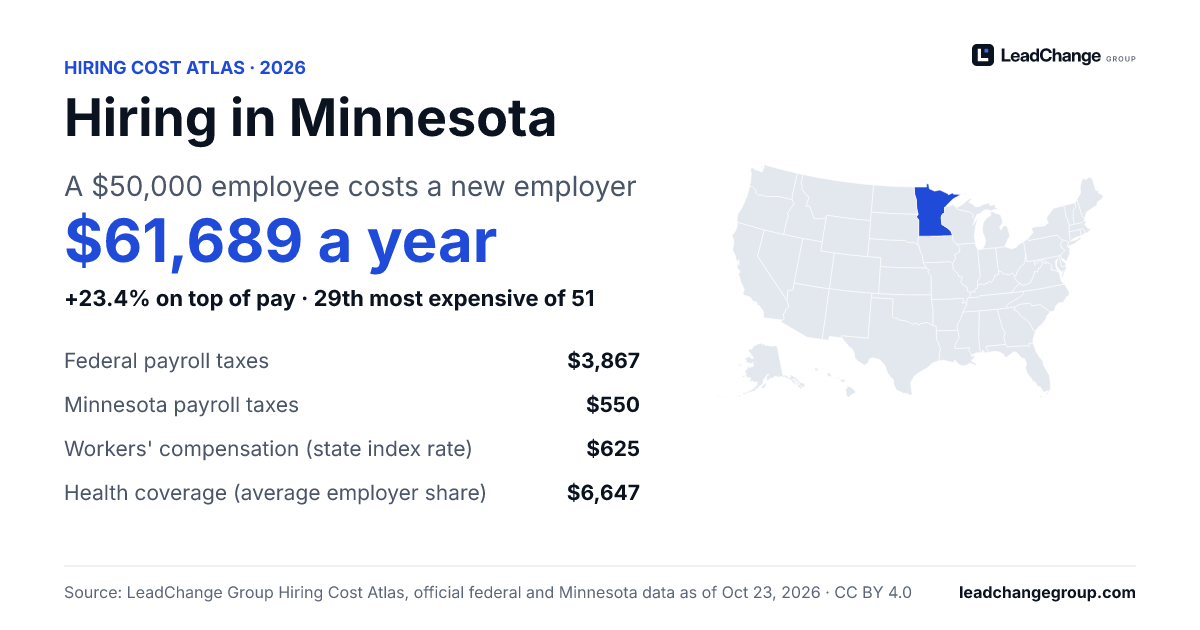
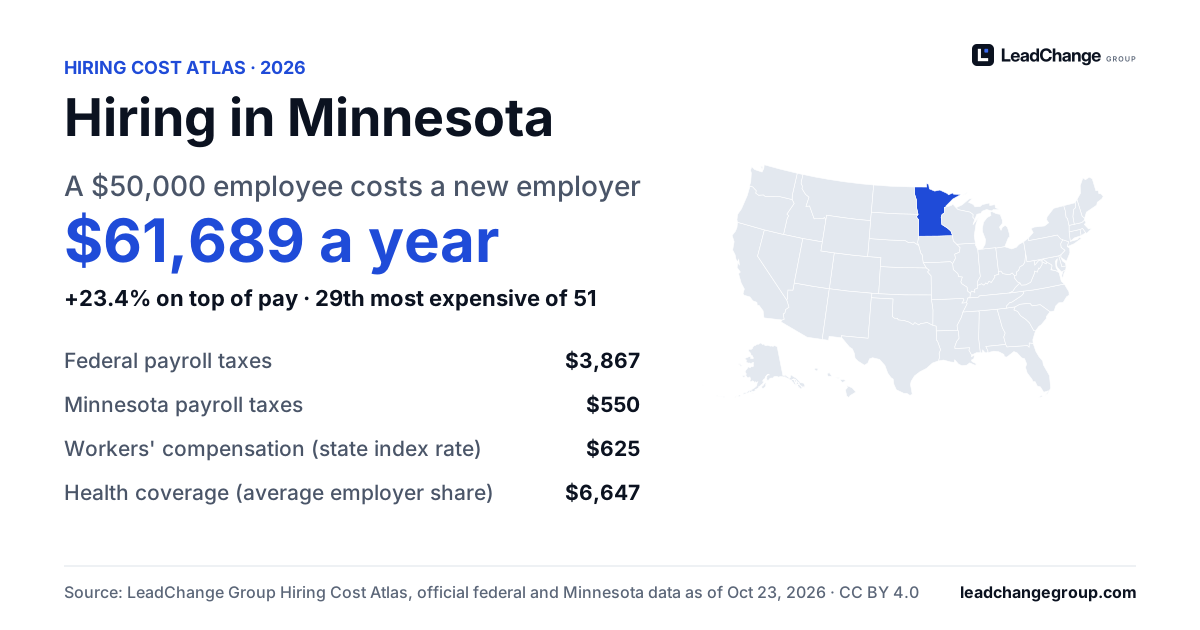
Two worked examples in Minnesota
Both for a new employer with 10 employees in a general industry in 2026, with single health coverage at the state average.
Salaried employee at $50,000
A $50,000 salary, 40 hours a week.
| Pay for hours worked2,032 hours | $48,846 |
|---|---|
| Paid sick leave required by law48 hours | $1,154 |
| Social Security (employer share)6.2% of $50,000 | $3,100 |
| Medicare (employer share)1.45% of $50,000 | $725 |
| FUTA (federal unemployment tax)0.6% of $7,000 | $42 |
| State unemployment insurance (new employer)1% of $44,000 | $440 |
| Minnesota Paid Leave (employer's minimum share)0.22% of $50,000 | $110 |
| Workers' compensation (state index rate)$1.25 per $100 of payroll | $625 |
| Health insurance (single coverage, state average)average employer contribution | $6,647 |
| Total cost a year | $61,689 |
23.4% on top of pay · $30.36 per hour worked
Hourly employee at $18 an hour
$18 an hour for 40 hours a week, 52 weeks.
| Pay for hours worked2,032 hours | $36,576 |
|---|---|
| Paid sick leave required by law48 hours | $864 |
| Social Security (employer share)6.2% of $37,440 | $2,321 |
| Medicare (employer share)1.45% of $37,440 | $543 |
| FUTA (federal unemployment tax)0.6% of $7,000 | $42 |
| State unemployment insurance (new employer)1% of $37,440 | $374 |
| Minnesota Paid Leave (employer's minimum share)0.22% of $37,440 | $82 |
| Workers' compensation (state index rate)$1.25 per $100 of payroll | $468 |
| Health insurance (single coverage, state average)average employer contribution | $6,647 |
| Total cost a year | $47,918 |
28% on top of pay · $23.58 per hour worked
What changes for Minnesota employers in 2027
- The Social Security wage base rises from $184,500 to $192,300: up to $484 more employer tax for employees paid above it. per Social Security Administration, as of Jan 1, 2027
- Minnesota's minimum wage becomes $11.87 an hour on January 1, 2027. per Minnesota Department of Labor and Industry, as of Jan 1, 2027
Not announced yet
- 2027 unemployment insurance wage base: not announced yet; 2026: $44,000. per U.S. Department of Labor, Employment and Training Administration, as of Jan 1, 2026
- 2027 new-employer unemployment rate: not announced yet; 2026: 1%. per Minnesota Department of Employment and Economic Development, Unemployment Insurance, as of Jan 1, 2026
Only changes already official on Oct 23, 2026. Most states publish next year's unemployment insurance rates in November and December; this page is updated when they do.
Frequently asked questions
How much does it cost to hire an employee in Minnesota?
About $61,689 a year in 2026 for a $50,000 employee of a new Minnesota employer with 10 staff: $11,689 above pay, of which $6,647 is health coverage, $625 workers' comp and $440 Minnesota unemployment tax. At $18 an hour full time: $47,918.
What payroll taxes do employers pay in Minnesota?
Minnesota payroll taxes on a $50,000 employee come to $4,417 a year for a new employer: $440 of Minnesota unemployment insurance at 1% on $44,000, $110 for Minnesota Paid Leave, $3,825 of Social Security and Medicare and $42 of FUTA.
What is the Minnesota SUTA rate for new employers in 2026?
It depends on the industry: Minnesota publishes 51 new-employer rates for 2026, 1% for most industries and from 1% to 8.9% (Site Preparation Contractors), on the first $44,000 of each employee's pay. Pick yours in the calculator.
Is paid sick leave required in Minnesota?
Yes. One hour of earned sick and safe time per 30 hours worked, up to 48 hours a year. That is 48 paid hours a year for a full-time Minnesota employee at 100 employees.
How much does workers' comp cost in Minnesota?
$1.25 per $100 of payroll at Minnesota's index rate (rank 17 of 51, 114% of the median): about $625 on $50,000 of pay.
How much do Minnesota employers pay for health insurance?
$6,647 a year per employee with single coverage and $18,934 with family coverage, the average Minnesota private-employer share of $8,586 and $25,947 premiums in 2025.
Does Minnesota have a paid family leave or disability tax for employers?
The 0.88% premium is split with employees: employers pay at least 0.44%; small employers (30 or fewer employees and an average wage at or below 150% of the state average) pay at least 0.22% of a reduced 0.66% rate. Wages are capped at the Social Security wage base.
More employer cost pages
Cities in Minnesota with their own rules
Minimum wage in Minnesota
Data and rules for every state
Terms on this page
Software and services for these costs
- Payroll Software
Calculates and files these payroll taxes for every state you hire in.
- PEO Services
Takes on payroll taxes, workers' comp and benefits, often at group rates.
- Benefits Administration
Runs the health plan and leave programs behind the benefits lines.
Benefits and workers’ comp are most of this cost
A PEO pools employers for health insurance and workers’ comp, often at group rates. Compare PEOs we research, with verified prices and features.